


Key takeaway: Managing the real cost of living in Canada requires budgeting for expenses beyond basic averages, such as projected annual grocery bills for families by 2026 and hidden housing fees like strata or municipal taxes. Understanding these regional price gaps and mandatory tax deductions is essential for maintaining purchasing power and long-term financial stability in diverse provincial markets.
The annual grocery bill for a family of four in Canada is projected to reach $17,572 by 2026, marking a significant jump of nearly $1,000 in just one year, according to Canada’s Food Price Report 2025, co-authored by researchers at Dalhousie University, the University of Guelph, the University of Saskatchewan, and the University of British Columbia (Charlebois et al., 2025). While national averages provide a baseline, they often mask the sharp regional disparities and hidden expenses that dictate your actual purchasing power.
Many residents find that their take-home pay disappears faster than expected due to progressive tax brackets and specialized costs like winter vehicle maintenance. This guide breaks down the real cost of living in Canada to help you navigate the financial landscape beyond the basic surface numbers.
- Real Cost Living Canada: Beyond The Basic Averages
- Regional Price Gaps Between Urban And Rural Areas
- Net Income And The Reality Of Tax Deductions
- Hidden Expenses From Climate To Connectivity
- Financial Strategies For Long Term Residency
Real Cost Living Canada: Beyond The Basic Averages
Monthly expenses for a single person vary considerably depending on the city, with costs rising sharply in high-demand urban centres like Toronto and Vancouver. Major costs include housing strata fees, a higher HST rate in Atlantic provinces, and specialized winter maintenance for vehicles and homes.
The last sentence about housing maintenance leads directly into the specific breakdown of secondary housing costs like strata and taxes.
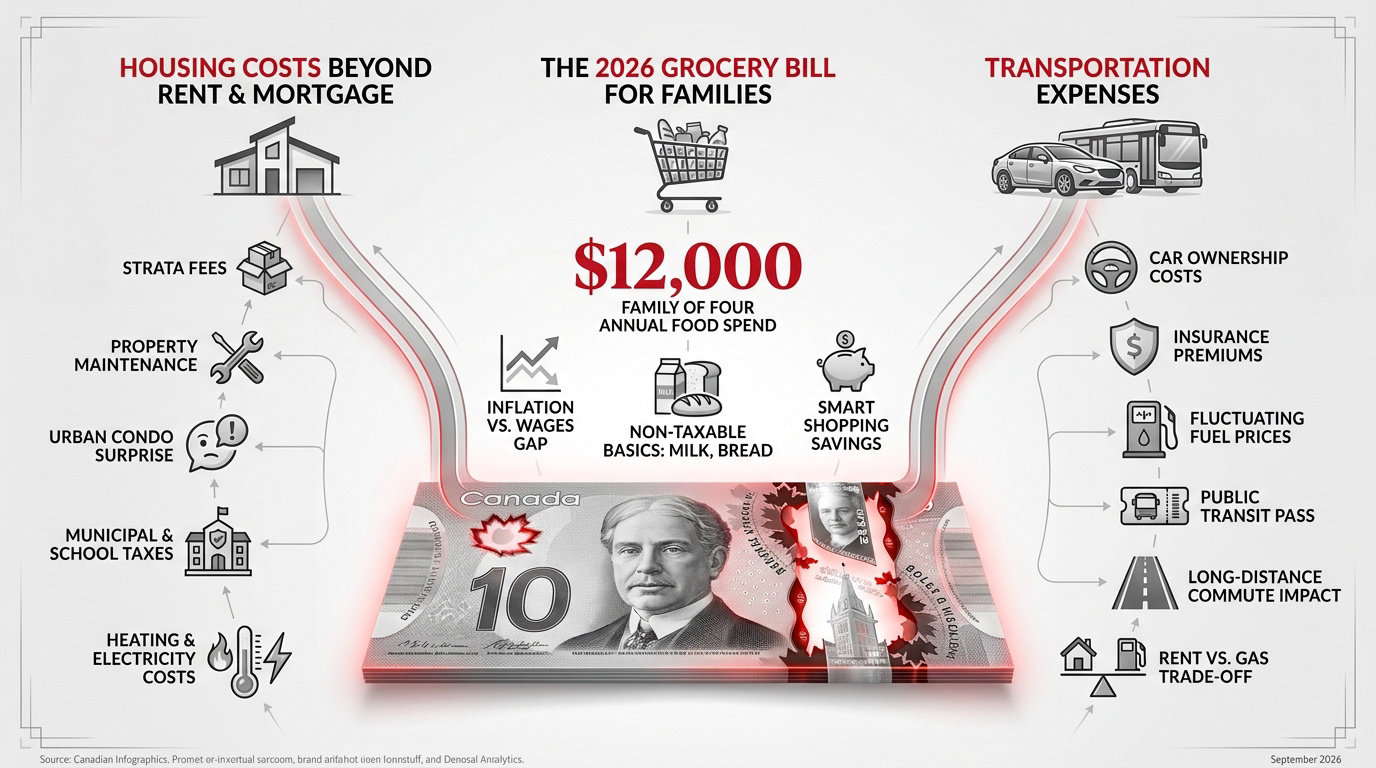
Housing Costs Beyond Rent And Mortgage
Owning a home involves hidden drains like strata fees for condos and constant exterior maintenance. These recurring costs frequently catch urban buyers off guard during their first year of ownership.
Municipal and school taxes significantly inflate annual budgets. Meanwhile, heating and electricity bills fluctuate wildly based on your housing type and local climate demands.
The 2026 Grocery Bill For Families
A family of four faces a staggering $17,572 annual food bill in 2026. This widening gap between inflation and stagnant wages creates real pressure.
Focusing on non-taxable basic food items like milk and bread helps stretch your dollars. Smart shopping remains the only way to combat these rising Canadian food prices.
Transportation Expenses For Car Owners And Transit Users
Car owners must juggle insurance premiums, registration, and volatile fuel prices. These costs quickly add up for every driver.
Public transit passes offer a cheaper alternative in dense urban centers. But, long suburban commutes often force a choice between high gas spending and lower monthly rent.
Regional Price Gaps Between Urban And Rural Areas
Moving from national averages to local realities reveals that where you live determines your purchasing power more than your gross salary.
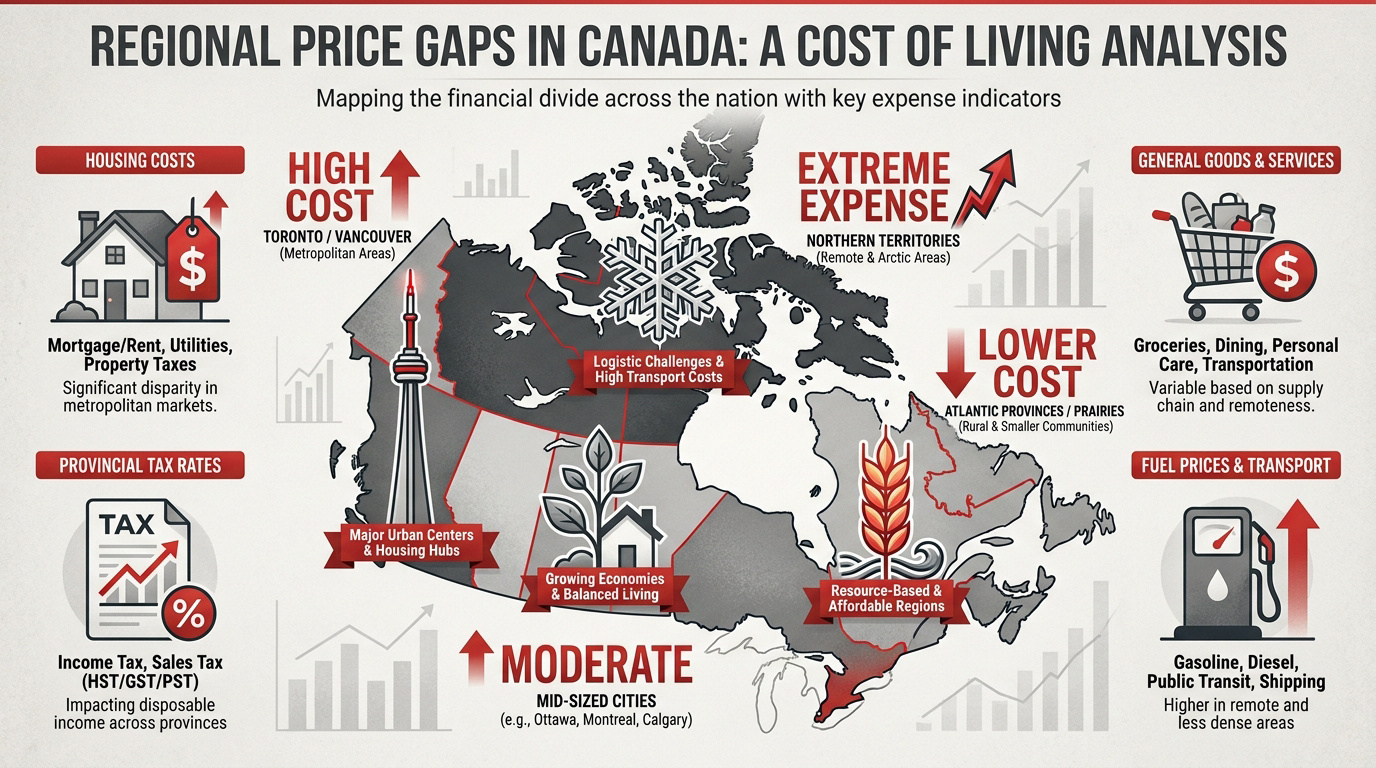
Living Costs In Toronto And Vancouver Hubs
Housing demand in Canada’s primary cities remains relentless. You pay a heavy premium for basic services and nightlife. Toronto and Vancouver clearly represent the most challenging financial markets today.
Mid-sized cities like Calgary or Ottawa offer a better deal. The rise of remote work makes these alternatives viable. You can actually save money by moving just a few hours outside the core hubs.
Affordability In The Atlantic Provinces And Prairies
Provinces like New Brunswick offer much lower housing entry points. You must weigh these savings against the local job market. It is a trade-off between cheaper rent and career opportunities.
Note how provincial tax rates affect your wallet. Some regions have higher sales taxes but significantly lower property costs. Balance your total budget by accounting for every single mandatory expense, not just rent.
The Extreme Expense Of Northern Living
Logistical hurdles naturally spike food and fuel prices. Northern territories deal with brutal supply chain constraints. Most goods must be flown or shipped in at a massive cost.
Residents rely on government subsidies to manage these bills. Northern budgets look nothing like Southern Canadian household spending. Fresh produce and heating fuel remain incredibly expensive in these isolated spots. The Real Cost of Living in Canada: What the Numbers Miss is often found in these hidden logistical markups.
Net Income And The Reality Of Tax Deductions
Moving to the next point, we need to look at what actually lands in your pocket.
Calculating Take-Home Pay After Mandatory Deductions
Gross salary is just a starting figure, not your actual spending power. Mandatory deductions for CPP and EI are non-negotiable subtractions for every worker. These payments fund your future security.
Estimating monthly cash flow accurately requires accounting for these automatic hits. Factor in employer-specific health premiums to avoid surprises. Knowing your net income helps prevent over-leveraging on rent or car payments. The Real Cost of Living in Canada: What the Numbers Miss often starts with this gap.
Progressive Taxation And Provincial Variations
Federal and provincial tax brackets hit high earners harder through a progressive system. Combined tax burdens vary significantly depending on where you live. Quebec and Ontario have very different structures for residents.
Sales taxes like GST, HST, and PST further erode your daily purchasing power. These consumption taxes quietly eat into every transaction you make. A high consumption tax rate on most goods changes your budgeting strategy significantly. It is a constant, invisible drain.
Subsidized Services And Out-Of-Pocket Health Costs
Public healthcare serves as a massive financial safety net for all residents. It covers doctors and hospitals, significantly reducing annual household spending. However, it does not cover every medical necessity.
Services like dental and vision usually require private insurance or direct payments. Subsidized childcare programs are expanding, but availability depends heavily on provincial policies. These out-of-pocket costs vary wildly based on where you settle and your specific coverage.
Hidden Expenses From Climate To Connectivity
Beyond the obvious bills, Canada imposes “hidden” costs ranging from extreme weather prep to notably high telecommunication rates. Transitioning from basic rent to the full reality of northern living reveals a steeper financial climb than many anticipate.
Seasonal Spending For The Canadian Climate
Quality winter clothing is a non-negotiable expense for families facing -30°C. Heavy-duty coats and specialized footwear often exceed $1,000 per household. Smart residents budget for these gear upgrades during the summer months.
Winter brings a sharp surge in heating bills, which dominate household utility costs. Vehicle owners must also pay for snow tires, often costing over $400 per set. These cold-weather requirements add a heavy, unavoidable layer to the annual budget.
Managing High Telecommunication And Internet Fees
Canadian mobile data rates are widely regarded as among the highest in the developed world. A basic 20GB plan typically costs around $40 monthly. Finding competitive deals requires constant negotiation and frequent shopping between providers.
Bundling internet with television services can sometimes lower the $74 average monthly web bill. High-speed connectivity is now a mandatory expense for remote work efficiency. A reliable home office setup is a vital investment for modern professionals.
Insurance Premiums And Unexpected Fees
Most landlords strictly require proof of tenant and homeowner insurance before move-in. These premiums, usually $20 to $50 monthly, are essential. They protect you from massive liabilities and sudden property loss.
Monthly banking fees and credit maintenance costs quietly drain your available balance. Newcomers face heavy initial settling-in costs, including furniture and household essentials. The Real Cost of Living in Canada: What the Numbers Miss often starts with these first-month spikes.
Financial Strategies For Long Term Residency
Surviving the first year is one thing, but building long-term wealth requires a shift from expense management to strategic investment.
Renting Versus Buying In The Current Market
Analyze the financial break-even point between leasing and ownership. Real estate offers significant wealth-building potential over decades. But buying isn’t always the smartest move immediately.
Evaluate the flexibility of renting in a fluctuating job market. Consider maintenance costs and property taxes before committing. Ownership carries risks that many first-time buyers often overlook in hot markets.
The Quality Of Life Dividend In Canada
Quantify non-monetary benefits like safety and public education. These reduce the need for private security or schooling. It is a hidden dividend for every resident.
Explain how social security nets provide long-term financial stability. Public infrastructure significantly reduces personal spending. Parks and libraries offer free recreation that offsets the high cost of living.
Banking Setup And Proof Of Funds For Newcomers
Detail the documentation required for opening bank accounts. Build a Canadian credit history early to avoid future hurdles. Without a score, securing loans or housing is difficult.
List the minimum funds required for initial settlement and transition. Be realistic about the first six months. Having a liquid buffer is the best way to handle the unexpected costs of relocation.
Mastering the true cost of living in Canada requires accounting for hidden housing fees, rising annual grocery bills, and high tax deductions. By budgeting for these regional nuances today, you secure a stable financial future. Navigate these complexities wisely to transform Canadian expenses into long-term wealth.
FAQ
What is the estimated monthly budget for a family of four living in Canada?
The monthly budget for a family of four varies significantly depending on the province. In more affordable regions like New Brunswick, expenses typically range between $4,300 and $4,800. However, in high-cost areas such as Ontario or British Columbia, families should prepare for costs between $6,600 and $7,900 per month.
For those considering the Northern territories, costs escalate further due to logistical challenges. In Nunavut, for instance, a family might need between $7,000 and $8,200 monthly to cover basic needs like food and heating fuel, which must often be flown or shipped in.
How much should I expect to spend on groceries for my family in 2026?
According to food price reports, a family of four is projected to spend approximately $17,572 annually on groceries in 2026. This represents a weekly bill of about $325. These figures reflect an anticipated price increase of 4% to 6%, with meat products expected to see the sharpest hikes of up to 7%.
To mitigate these rising costs, shoppers can focus on non-taxable basic food items such as milk and bread. Smart shopping strategies, including meal planning around discounts and cooking at home, are essential to offset inflation that continues to outpace wage growth.
What are the hidden costs associated with owning a home in Canada?
Beyond the mortgage, homeowners must budget for municipal and school taxes, which are calculated based on local property assessments. In urban condo markets, strata fees (condo fees) are a mandatory expense that covers building maintenance and the reserve fund, though these can increase if the corporation is underfunded.
Additional recurring costs include home insurance, which averages $960 to $1,103 annually, and seasonal maintenance. In the Canadian climate, expenses for heating (which can account for 54% of energy bills) and specialized services like snow removal are critical factors in a realistic housing budget.
Is public transit a viable way to save money compared to owning a car?
Yes, public transit offers significant savings, with monthly passes generally ranging from $128 to $143 in major hubs like Toronto. In contrast, owning a new vehicle requires an initial investment of at least $21,000, plus ongoing costs for insurance premiums (averaging $1,067), fuel, and registration.
However, the trade-off often involves a “commuter tax” of time. While transit is cheaper, those living in suburbs for lower rent may face long-distance commutes. Residents must balance the financial benefit of a $3.30 single fare against the flexibility and maintenance requirements of a private vehicle.
How do Canadian taxes and mandatory deductions affect my take-home pay?
Your net income is significantly lower than your gross salary due to Canada’s progressive tax system and mandatory payroll deductions. Every worker must contribute to the Canada Pension Plan (CPP) and Employment Insurance (EI). Furthermore, sales taxes like the GST, HST, or PST, which reach their highest combined rates in Atlantic provinces, further reduce daily purchasing power.
Provincial variations are also stark; for example, a resident in Quebec faces a different tax structure than one in Alberta. Understanding these brackets and available tax credits, such as the basic personal amount or childcare deductions, is vital for accurate monthly cash flow planning.
What seasonal expenses should I budget for to handle the Canadian winter?
The Canadian climate demands specific seasonal spending, starting with winter clothing. A quality parka can cost between $200 and $1,000, while insulated boots range from $100 to $250. Families should also budget for heating bills, which surge during the coldest months regardless of the energy source.
For car owners, winter tires are a mandatory or highly recommended expense, with sets starting around $400 to $800 excluding installation. Budgeting for these “hidden” climate costs during the summer months helps prevent financial strain when the temperature drops.
Why are telecommunication fees so high in Canada?
Canada has some of the highest mobile data and internet rates globally. A basic 20GB cellular plan costs around $40, while high-speed internet for remote work can range from $40 to $100 per month. Total communication bundles, including television, often reach $250 monthly.
To manage these fees, residents are encouraged to negotiate with providers regularly and shop for competitive bundles. Evaluating actual data usage and opting for internet-based calling (VoIP) can also help reduce the impact of these notoriously high connectivity costs.
FAQ
What is the estimated monthly budget for a family of four living in Canada?
The monthly budget for a family of four varies significantly depending on the province. In more affordable regions like New Brunswick, expenses typically range between $4,300 and $4,800. However, in high-cost areas such as Ontario or British Columbia, families should prepare for costs between $6,600 and $7,900 per month.
For those considering the Northern territories, costs escalate further due to logistical challenges. In Nunavut, for instance, a family might need between $7,000 and $8,200 monthly to cover basic needs like food and heating fuel, which must often be flown or shipped in.
How much should I expect to spend on groceries for my family in 2026?
According to food price reports, a family of four is projected to spend approximately $17,572 annually on groceries in 2026. This represents a weekly bill of about $325. These figures reflect an anticipated price increase of 4% to 6%, with meat products expected to see the sharpest hikes of up to 7%.
To mitigate these rising costs, shoppers can focus on non-taxable basic food items such as milk and bread. Smart shopping strategies, including meal planning around discounts and cooking at home, are essential to offset inflation that continues to outpace wage growth.
What are the hidden costs associated with owning a home in Canada?
Beyond the mortgage, homeowners must budget for municipal and school taxes, which are calculated based on local property assessments. In urban condo markets, strata fees (condo fees) are a mandatory expense that covers building maintenance and the reserve fund, though these can increase if the corporation is underfunded.
Additional recurring costs include home insurance, which averages $960 to $1,103 annually, and seasonal maintenance. In the Canadian climate, expenses for heating (which can account for 54% of energy bills) and specialized services like snow removal are critical factors in a realistic housing budget.
Is public transit a viable way to save money compared to owning a car?
Yes, public transit offers significant savings, with monthly passes generally ranging from $128 to $143 in major hubs like Toronto. In contrast, owning a new vehicle requires an initial investment of at least $21,000, plus ongoing costs for insurance premiums (averaging $1,067), fuel, and registration.
However, the trade-off often involves a “commuter tax” of time. While transit is cheaper, those living in suburbs for lower rent may face long-distance commutes. Residents must balance the financial benefit of a $3.30 single fare against the flexibility and maintenance requirements of a private vehicle.
How do Canadian taxes and mandatory deductions affect my take-home pay?
Your net income is significantly lower than your gross salary due to Canada’s progressive tax system and mandatory payroll deductions. Every worker must contribute to the Canada Pension Plan (CPP) and Employment Insurance (EI). Furthermore, sales taxes like the GST, HST, or PST (reaching 15% in Atlantic provinces) further reduce daily purchasing power.
Provincial variations are also stark; for example, a resident in Quebec faces a different tax structure than one in Alberta. Understanding these brackets and available tax credits, such as the basic personal amount or childcare deductions, is vital for accurate monthly cash flow planning.
What seasonal expenses should I budget for to handle the Canadian winter?
The Canadian climate demands specific seasonal spending, starting with winter clothing. A quality parka can cost between $200 and $1,000, while insulated boots range from $100 to $250. Families should also budget for heating bills, which surge during the coldest months regardless of the energy source.
For car owners, winter tires are a mandatory or highly recommended expense, with sets starting around $400 to $800 excluding installation. Budgeting for these “hidden” climate costs during the summer months helps prevent financial strain when the temperature drops.
Why are telecommunication fees so high in Canada?
Canada has some of the highest mobile data and internet rates globally. A basic 20GB cellular plan costs around $40, while high-speed internet for remote work can range from $40 to $100 per month. Total communication bundles, including television, often reach $250 monthly.
To manage these fees, residents are encouraged to negotiate with providers regularly and shop for competitive bundles. Evaluating actual data usage and opting for internet-based calling (VoIP) can also help reduce the impact of these notoriously high connectivity costs.