
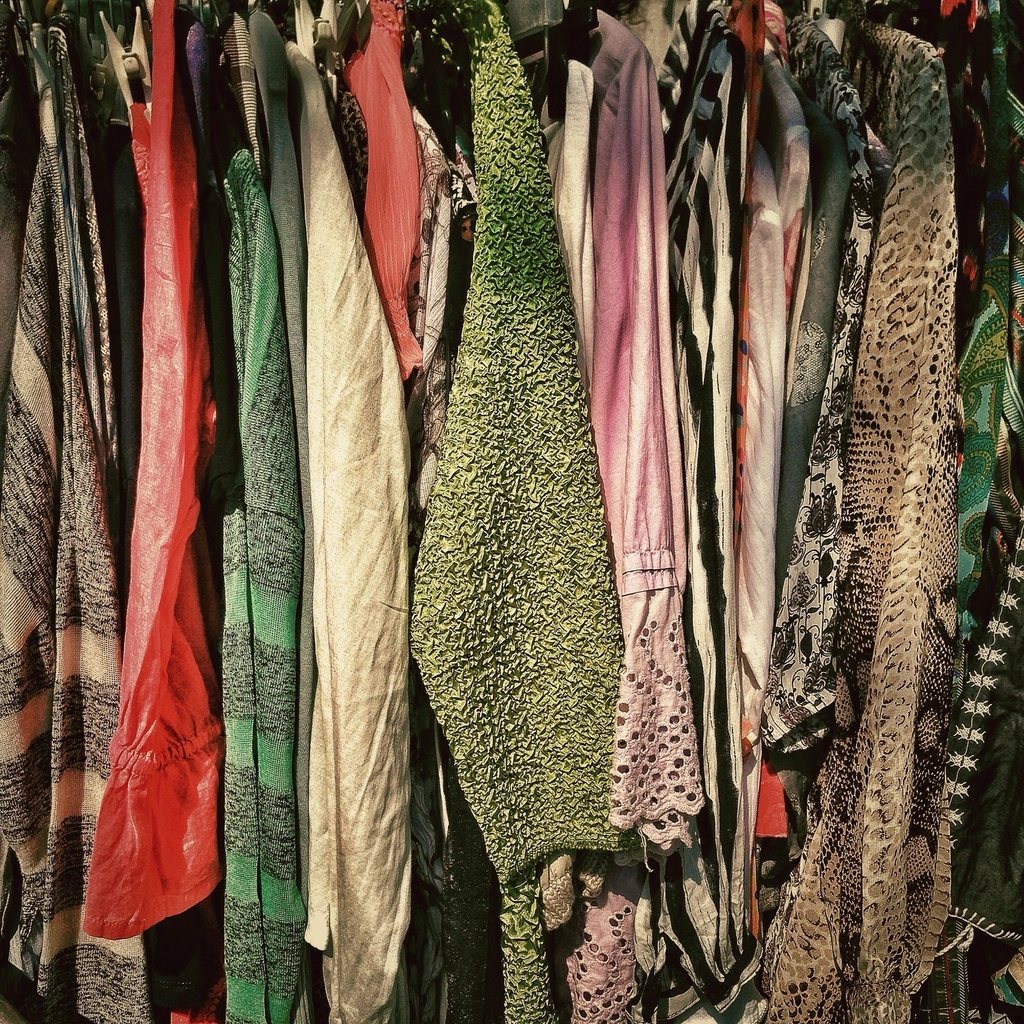

Somewhere in the last decade, the question changed. It used to be “where did you get that?” and the honest answer, if it was a thrift store, came with a small apology or a small boast, depending on the room. Now the question is “how much did you pay?” and the winning answer is the lowest one. We think that shift is the most important thing that has happened to Canadian fashion since the parka, and it has almost nothing to do with fashion.
Walk the second-hand strips of any city and you can see it. Kensington Market in Toronto, Mont-Royal Avenue and the north end of Saint-Laurent in Montreal, Commercial Drive in Vancouver, Whyte Avenue in Edmonton, Agricola Street in Halifax: each has more racks of used clothing than it did ten years ago, and the crowd flipping through them is not the crowd the thrift shop used to serve. It is everyone.
From necessity to mode
Thrift in Canada was never a subculture so much as a quiet baseline. Church basements, charity shops and the back rooms of community centres clothed a lot of the country through the twentieth century, and nobody wrote about it. What has changed is the top of the market, not the bottom. The people who used to buy new now buy used first and new only when used fails, and they say so out loud.
The reasons stack up in a familiar order. Prices for new clothing rose faster than wages through the early 2020s. The quality of new clothing fell in the same period, as fast-fashion construction migrated from the cheap racks to the mid-priced ones. Online resale made it possible to search a whole city’s closets from a couch. And a generation that grew up hearing about textile waste, an estimated half a billion kilograms of it discarded in Canada every year according to university researchers, decided that buying used was the easiest ethical decision available.
The winter coat economy
If you want to understand Canadian thrift, start with the coat. A serious winter coat is the one garment in this country that is not optional. In Montreal the average January high sits around minus five degrees Celsius and the lows go well past minus fifteen; in Winnipeg and Edmonton the lows routinely reach minus thirty. A new down parka built for those numbers costs several hundred dollars at the low end and over a thousand at the high end, and it is expected to last a decade.
That combination, high price and long life, is exactly what makes a resale market work. A five-year-old parka is still a good parka. Every autumn, from late September through the first real snowfall in November, the second-hand coat racks in every major city fill and empty in a rhythm that the new-clothing trade would envy. Students, newcomers facing their first winter and parents of children who grew over the summer all shop the same racks, and the good coats are gone by Thanksgiving.
The coat also explains something about the class politics of thrift. A used parka from a well-made source is warmer than a new one from a cheap source at the same price. Buying second-hand, in this case, is not the thrifty choice. It is the correct one, and everyone has figured that out.
Repair as the second half of the deal
A wardrobe built on used clothing depends on someone being able to fix it. That is the part of the story we find most encouraging, because it has grown from almost nothing. Now there are repair cafes in community centres and libraries in most large cities, usually monthly, where volunteers with sewing machines and patience will show you how to darn a sock or patch a knee for free. Small alteration shops have reopened on the same strips as the thrift stores, and their windows advertise zipper replacement and reproofing rather than hemming.
Public policy caught up late. Canada’s right-to-repair amendments to copyright law, which cleared Parliament in 2024, were written with electronics in mind, but the principle is spreading. Quebec passed its own repairability rules in 2023 covering warranty and parts availability for consumer goods. Clothing does not need legislation to be repairable; it needs people who know how, and a culture that does not treat a patch as a confession. That culture is here now. A visible mend on a wool coat in Montreal or Toronto reads as care, not poverty.
What it says about class and taste
Here is where we want to be careful. The mainstreaming of thrift has been good for waste, good for wallets and bad, in some specific ways, for the people who needed it first. When the well-paid start shopping the same racks, prices at the curated end of the second-hand trade rise, and the best pieces get skimmed by resellers before they reach the floor. The charity shop in a low-income neighbourhood now competes with an online listing service for the same donated coat.
At the same time, the shift has quietly dismantled one of the oldest signals in Canadian dress: that new meant respectable. For most of the last century, wearing visibly used clothing to a job interview, a courtroom or a family dinner marked you. That marker is fading fast, and its fading is a small act of class levelling that nobody legislated. When a used coat is the smart choice and a mended one is the admired choice, the person who could only ever afford used has lost a stigma without having to gain a dollar.
Taste has moved with it. The Canadian look of the moment, if there is one, is layered, slightly oversized, mixed in era and heavy on wool and canvas. That is not a runway decision. It is what the racks contain. A country’s style is always shaped by its supply chain, and for the first time in a long while, the supply chain runs through its own closets.
What we notice on the rack
A few things are consistent from city to city, and they tell you where this is headed:
- Coats and boots move fastest and are priced closest to new, because winter does not negotiate.
- Wool, leather and canvas hold value; synthetics do not.
- Repairs are increasingly visible and deliberate, with contrasting thread and patches shown rather than hidden.
- Children’s clothing circulates almost entirely second-hand, through swaps as much as shops.
- The best racks are in neighbourhoods that were affordable twenty years ago and are not now, which is its own commentary.
The wardrobe as a public thing
We keep coming back to an image from a Montreal repair cafe last winter: a table of strangers, three sewing machines, a pile of coats with broken zippers, and nobody in a hurry. It looked less like shopping than like a library. That may be the real story of Canadian thrift. Clothing has stopped being a private purchase and become something closer to a shared resource, passed along, patched up and passed along again. It is not glamorous. It is warm, it is cheap, and it fits. In this country, that has always been the point.