

There is a particular kind of quiet that settles over a Canadian city in the second week of January. The holiday lights come down, the sidewalks narrow to a shovelled trench, and the question of where to go, if you are not at home and not at work, becomes surprisingly hard to answer. We have been asking it a lot lately, and the answers keep shrinking.
The sociologist who coined the term “third place” in 1989 meant the informal public settings that are neither home nor workplace: the cafe, the barbershop, the tavern, the corner store with a bench out front. They are cheap or free, they are close, and nobody needs a reason to be there. That last part matters more than it sounds. A third place is where you run into people you did not plan to see, and in a country where winter can last five months, that accident is the social glue.
The cafe that closed at four
Walk down almost any commercial strip in Toronto, Montreal, Calgary or Halifax and you will find the pattern. The independent cafe that used to stay open until nine now closes at four, if it is still there at all. The one that replaced it has fewer chairs, a counter angled toward the takeout line, and a sign that discourages laptops. We do not blame the owners. Rents on a main street have climbed faster than the price anyone will pay for a coffee, and a table occupied for three hours by a single cup is a table that does not pay the lease.
But something is lost when the cafe becomes a dispensary rather than a room. The regulars who used to hold down the window seat, the students who nursed a tea through a snowstorm, the retiree who read the paper every morning at ten: they were not customers so much as furniture, and a room needs furniture. The retail logic that makes a cafe efficient is the same logic that makes it useless as a third place.
The library becomes the last free room
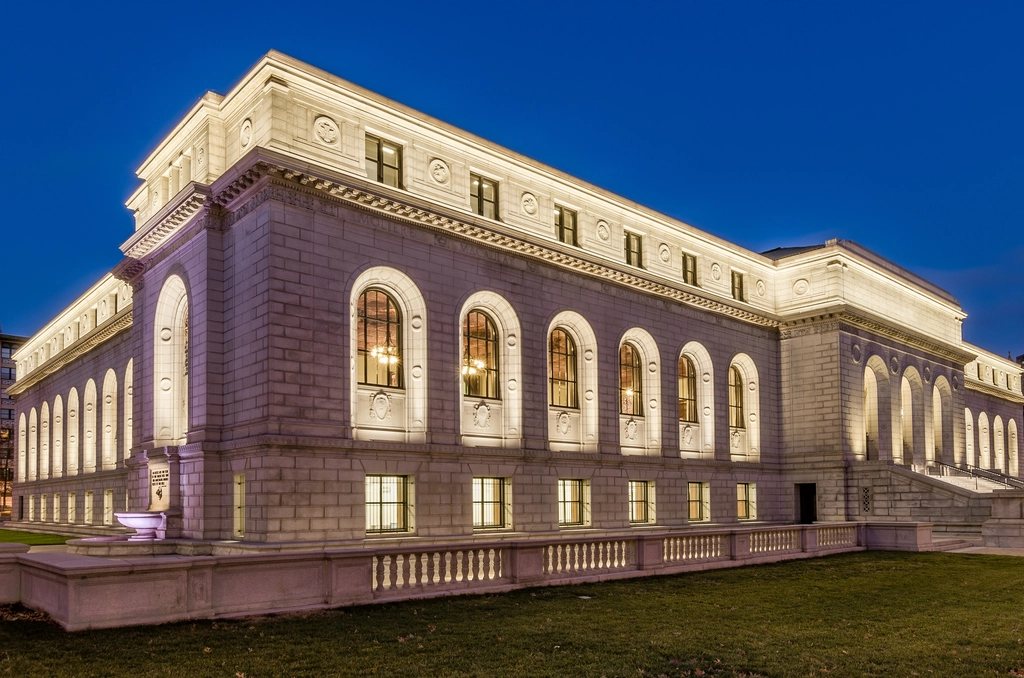
Ask anyone who works in a public library what the building is for, and the answer has changed. Books are still there, but the busiest floors are the ones with chairs, outlets, washrooms and heat. In Toronto, the public system runs a hundred branches, which makes it one of the largest urban library networks in the world by that measure. Halifax opened its glass central library on Spring Garden Road in 2014, and it became a civic living room almost immediately. Calgary followed in 2018 with a central library that draws people who have no intention of borrowing anything. Montreal’s Grande Bibliotheque, open since 2005 on the edge of the Quartier Latin, fills its reading rooms by midmorning on a cold day.
This is a success story on the surface, and we mean that. But it also describes a city that has quietly delegated all of its free indoor social space to a single institution. When the library is the only warm room that asks nothing of you, the library ends up doing the work of the shelter, the community centre, the employment office and the cafe at the same time, on a budget designed for books. Staff know this. Branch workers in every large Canadian city now train for overdoses, mental health crises and the simple logistics of a person who has nowhere else to sit for eight hours.
Winter makes the problem visible
In most of the country, the third-place problem is seasonal in the way a leaking roof is seasonal: it only shows when it rains. From May to October, a park bench, a stoop, a patio or a lakeshore path does the job for free. Then the temperature drops, and the map of places where a person can exist without paying collapses to a handful of points. Montreal’s average daytime high in January sits below minus five degrees Celsius. Winnipeg and Edmonton spend long stretches below minus twenty. Under those conditions, the difference between a city with warm public rooms and a city without them is not a lifestyle question.
Municipalities know this too, which is why they open warming centres when forecasts cross a threshold. Those centres are necessary and they are also an admission: a warming centre is what a city builds when it has stopped building third places.
Loneliness has a floor plan
We tend to treat loneliness as a private condition, something that lives inside a person. It has a geography as well. Statistics Canada’s social surveys since 2021 have found that roughly one in eight Canadians aged fifteen and over report feeling lonely always or often, with the highest rates among young adults and among people who live alone. Those are exactly the groups most dependent on places they do not own: renters in small apartments, students, newcomers, seniors on fixed incomes. A person with a large house and a backyard can host. A person in a bachelor unit on the eleventh floor needs somewhere to go.
What strikes us, reading those numbers, is how much of the response has been individual. Apps, meetup groups, ticketed events, memberships. Each of them puts a price or a schedule on something that used to be ambient. You cannot stumble into a ticketed event. The whole point of a third place is that you do not decide to go; you are just there.
What a city owes the people who live in it
We would put the obligation plainly. A city that collects property tax, sets rents through zoning and licenses every business on its main streets has a hand in whether those streets have anywhere to sit. It does not have to run cafes. It can do smaller things that add up:
- Keep library and community centre hours long, especially evenings and Sundays, when the need is highest and the alternatives are fewest.
- Treat heated indoor public space as infrastructure, on the same footing as roads and transit, and fund it that way.
- Give small independent businesses that keep chairs and washrooms open to non-customers a break on licensing or property tax, the way some municipalities already do for heritage facades.
- Design transit stations, malls and civic lobbies with seating that is not deliberately uncomfortable.
- Stop assuming the private sector will provide the room. It has spent twenty years proving that it will not.
The room is the point
There is a version of this argument that ends in nostalgia, and we want to avoid it. The old cafe was not perfect; the old tavern excluded half the population; the church hall came with strings attached. What we are defending is not any particular building but a principle: that a person should be able to be somewhere, warm, unhurried and unbilled, and see other people doing the same. Toronto, Montreal, Halifax and Calgary each have a few such rooms left, and most of them have a library card catalogue somewhere in the corner. That is not a coincidence, and it is not a plan. It is what a city looks like when it forgets that the room, not the coffee, was always the point.